By George Williams
Have you ever wondered how it’s possible for a horse to piaffe energetically straight on the centerline at X with well-engaged haunches and be confident, relaxed, rhythmical, in self-carriage with a nice contact? As with many things in dressage, it has to do with the attention to detail and the careful development of the horse along the established principles of training.
New for 2026, the FEI has changed the General Impression mark at the bottom of the dressage tests to “Harmony.” Included in the mark is “harmony, cooperation, lightness, effectiveness and sensitivity of the aids as well as adherence to the training scale.” With that in mind, I thought it might be a good time to zero in on an aspect of the training scale that I find to be crucial when we’re seeking some of the qualities we want to create by following the training scale: “freedom and regularity of the paces, harmony, lightness and ease of movements, lightness of the forehand and engagement of the hindquarters, originating from a lively impulsion with an acceptance of the bridle, with thoroughness without any tension or resistance.” There is this little thing referred to as looseness.
Like with contact and connection, the dressage terms suppleness and looseness are, in my opinion, not interchangeable. To my mind, looseness is its own quality, similar to suppleness but slightly (and importantly) different—a quality that, when done well, is a result of suppleness. When thinking of straightness and where it falls in the training scale, there is the realization that there are many different degrees of straightness, especially as it is continually developed through years of training to the level necessary to allow for the highest degree of collection. For example, we need basic straightness to ride straight lines. Later, we need our horses to be equally supple on both sides (one of the qualities of straightness) to ride good figure eights, or changes of direction—say, from one volte to another. Ultimately, we need a level of straightness that allows for alignment within the frame of the horse’s body in order to perform a good piaffe.
In our American version of the training scale, i.e., the Pyramid of Training, we frequently use the word relaxation or suppleness as the second tier of the pyramid. Relaxation is certainly part of that second tier, as is suppleness, but perhaps not the most complete description of what we ultimately want to achieve. When both are fully developed, together they create looseness. Recently, my student put it very well when she summed up my long-winded explanation—and clearly wanted to get back to riding—“So relaxation is a state of mind and looseness is a state of body?”
One thing is certain: faking suppleness through bending, positioning or flexions produced incorrectly while ignoring relaxation will not produce looseness, and neither will focusing only on relaxation without stretching or suppling exercises.
It can no doubt be confusing, because we frequently mix up the terms when describing what we’re asking for: for example, creating looseness versus riding loosening exercises. There is a difference between creating looseness versus riding loosening exercises. To be clear, there are loosening exercises that are similar, if not the same, as suppling exercises. However, those are slightly different from the type of looseness we’re looking for. True, both loosening/suppling exercises and looseness create a freer way of going.
Looseness requires a precise and subtle interaction between inside aids and outside aids, creating a “letting go” effect of the top line, especially in the withers area. When done well, it creates freedom in the shoulder and greater expression in the movements; or, as is looked for under the general impressions of our national tests, ease of movement. It allows the horse to develop an independent balance, a rhythmical swing through the back and a cadenced, confident, effortless way of moving.
In practical terms, looseness can frequently be created by simply slightly hinting toward a suppling exercise, creating greater alignment within the horse’s body.
Looseness does, however, require active, engaged hind legs. Well-timed half halts encourage the horse to use the ground to step down and push off with more thrust. In general, half halts are frequently misunderstood and incorrectly applied, resulting in holding the horse back. This is a fundamental mistake and will only create the opposite effect from what we desire: a forward-thinking, well-balanced and supple horse.
Bottom line: to achieve harmony throughout a test, all the elements of the training scale in their highest, most developed form should be present. This includes the most advanced of the Grand Prix movements such as the piaffe, passage, pirouettes and flying changes every stride. Hence, harmony is displayed when there is an understanding between horse and rider: The horse willingly shows acceptance and cooperation, while the rider shows empathy and is in unity with their horse, consistently creating a frictionless interaction between the horse and rider. And that, my friends, is the Holy Grail.
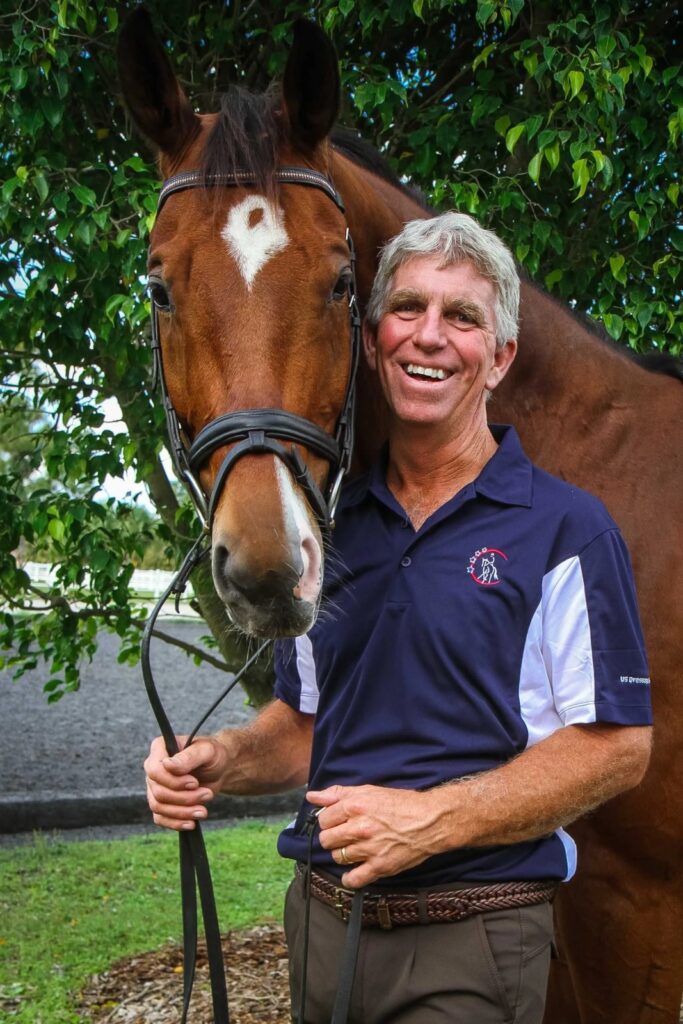
George Williams has dedicated his life to dressage as a rider, coach, clinician and volunteer. He studied with Egon von Neindorff in Germany and then followed his mentor, Karl Mikolka, to ride and train with the Tempel Lipizzans for 20 years before pursuing his own competitive goal to ride on a U.S. team. George succeeded with Rocher, earning accolades including 2005 USDF Grand Prix and Grand Prix Freestyle Horse of the Year. He’s trained many young riders to prestigious finals and served on the US Equestrian Dressage Committee, the US Equestrian Board of Directors and the United States Dressage Federation, of which he served as president for a total of 12 years. Now, George is the US Equestrian Dressage Youth Coach and on the FEI Dressage Committee in addition to teaching clinics.
Do you have a question you want George to answer? Send questions to .
Sign up for our mailing list to stay up to date with all things Sidelines!