By Shya Beth
From the outside, steel seems cold, immovable—an industrial product of fire and force. But when shaped by the hands of Scottish sculptor Andy Scott, it becomes something else entirely: a living presence, a breath caught in metal, an echo of muscle and spirit that pulses through the form of a horse. His monumental equine sculptures rise from landscapes across the world, yet his journey into this world of immense steel horses didn’t begin with a welder’s torch. It began quietly, almost unexpectedly, as a teenager discovering that art could be a life.
“I was accepted into a residential art course for talented kids,” he said. “It opened my eyes to the possibility of being an artist.” A few years later, the Glasgow School of Art cemented his direction in the 1980s, even if it did not teach him everything he would one day need. “The tutors were rooted in abstraction from the decades before,” he explained. “But the technicians taught me metalwork, and the rest I taught myself.”
Raised in a modest, working-class household, Andy’s path to becoming an artist may not have been the obvious one. But his parents recognized something early, and not only did they encourage him, they fed his imagination. “They were very supportive of my aspirations,” Andy said. “They made me deeply aware of the Victorian and Edwardian architecture and statuary of Glasgow. That environment became my early inspiration.”
It’s little wonder, then, that steel, born of Glasgow’s industrial legacy, became his chosen medium. The city’s shipyards and engineering works formed the backdrop of his childhood and seeped into his artistic vocabulary long before he touched a welding torch. And when Andy did start welding, his career didn’t follow a tidy trajectory. There was no strategic plan, no gallery-fueled launch, no early patron. “It was a rollercoaster ride with no game plan,” he said. “One commission led to another. I still have no idea what I’ll be doing a year from now, other than working hard.”
Those early years were defined by grit and perseverance. In the 1980s, public art was not the cultural priority it is today. “It took 10 years of hard work to land my first major public project,” he explained. Convincing city councils and developers to embrace contemporary figurative sculpture, especially on a monumental scale, was nearly unheard of. “I guess my modest success came from the public reaction,” he said. “That created an appetite for the next job, and the next.”
His ascent, however, has never been a one-man mission. His wife, Hanneke, who is an architect, co-runs the sculpture studio, handling logistics, business and complex planning. “Everything we do is a team effort,” he said. “I’m eternally indebted to her.”

Despite the global span of Andy’s work, horses have become his most profound artistic collaborators. Though he isn’t a rider and his connection to equines isn’t rooted in daily barn life, he returns to them again and again, drawn by their historical weight and emotional resonance.
“My great-grandfather worked Clydesdales on the Glasgow docks,” he shared. “I never knew him, but I suppose that connection lingers somewhere. When you sculpt a horse, you’re locking horns with the big guns of art history. It’s not about anatomical perfection or creating a carbon copy. My goal is energy, dynamism, passion, all the intangibles that define our relationship with horses.”
Andy’s research has taken him into barns, breeding registries and working stables. He has observed Friesians in The Netherlands, Clydesdales in Glasgow, draft horses in Australia and beyond. What begins as an aesthetic exercise becomes, over time, deeply personal. “When a sculpture takes shape, it develops a presence and a personality. It becomes hard not to grow attached to it,” he said. “The studio feels empty when they leave.”
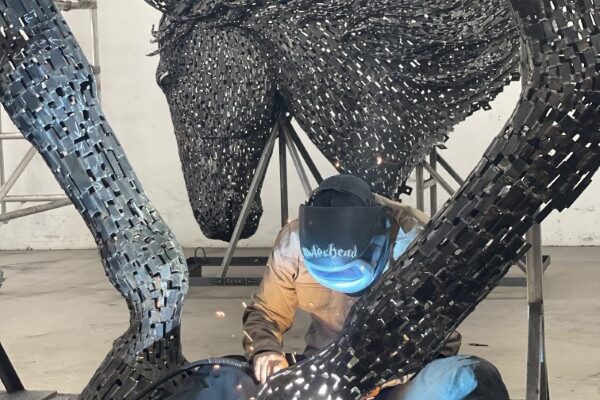
“I had a moment of epiphany while seeing a Chuck Close exhibition,” Andy recalled. Inspired by the painter’s pixelated realism, he wondered whether he could translate the concept into metal. The answer, as seen in his monumental sculptures, is a resounding yes.
The process requires far more than artistic instinct. It demands engineering foresight, structural knowledge and logistical planning. Everything, from trucking weight to crane access to galvanizing requirements, is imagined at the earliest stages. “It comes as second nature now,” he said. “We design with practicality and poetry side by side.”
Among all his works, none carry the emotional weight of “The Kelpies,” the 100-foot-tall Clydesdale-inspired sculptures in Scotland that have become global landmarks. “They took a huge chunk of our lives,” he said. “Hundreds of people contributed, and the reward is extraordinary. To see them now, to know they draw nearly a million visitors a year—it means everything.”
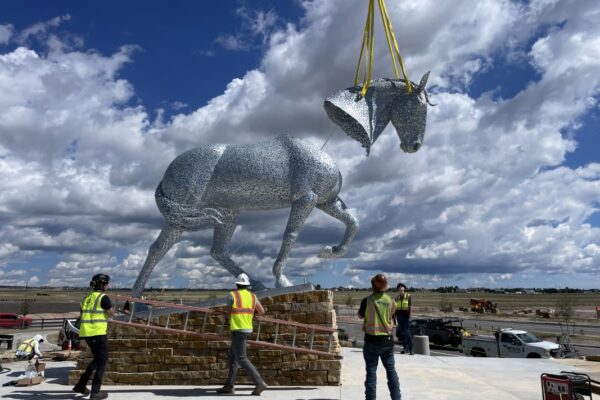
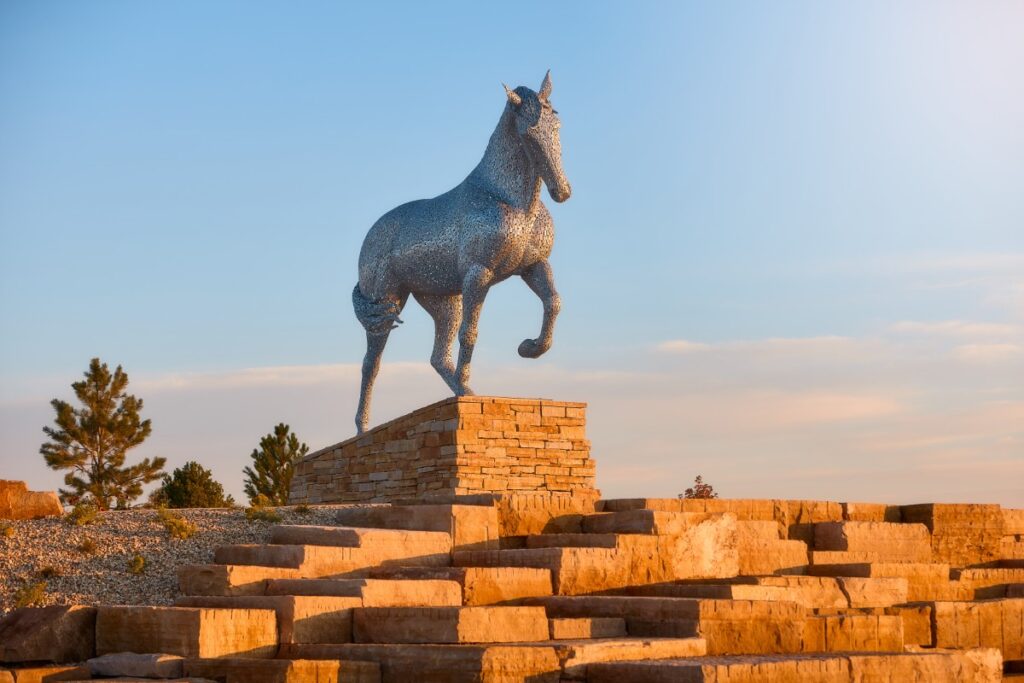
His latest commission takes him to Colorado Springs, Colorado, where a 15-foot Percheron mare sculpted in steel has risen at the entrance of a new development, and the location felt destined from the beginning. The land once belonged to Ruth Banning, who bred Percherons there in the early 1900s. “It seemed only right to honor her pioneer spirit,” he said.
Inspired by winds off the Rockies, he sculpted the mare’s mane and tail blowing forward, as if caught in the afternoon gusts common to the site. She steps gracefully, not straining, as if returning to pasture after a long day’s work.
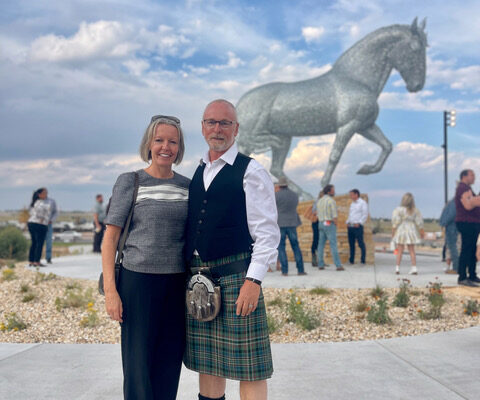
Structural challenges, especially with a raised front hoof and the tremendous weight of steel, necessitated innovations within the internal supports. “We used a neat structural trick,” he said, “so the sculpture retains elegance without compromising stability.”
With a draft horse rescue center nearby and a landscape rich in equine history, the sculpture feels full circle. Above all, he wants the Colorado community to feel ownership. “It’s important that they feel like it’s theirs,” he said, “that it belongs in that place. A sculpture succeeds when it becomes impossible to imagine the landscape without it.”
For more information, visit andyscottsculptor.com
Photos by Andy and Henneke Scott
Sign up for our mailing list to stay up to date with all things Sidelines!