 By Britney Grover
Many Thoroughbreds are born and bred to race. Some of them love to run and would finish a race riderless; others never quite hit their stride on the track. But they all deserve caring homes when they retire from an injury, lack of competitiveness or after a long and successful racing career. That’s where CANTER, Communication Alliance to Network Thoroughbred Ex-Racehorses, comes in, with 13 branches around the country working to rehome retiring racehorses.
Denise Lindsey founded CANTER Pennsylvania in 2004. “Denise felt strongly that if retiring ex-racehorses could be made available to sport riders, more would find quality homes and both industries would benefit from the relationship,” said Sue Smith, who became executive director when Denise retired. “She decided to follow the format first initiated by CANTER Michigan in 1997, a 100 percent volunteer-run organization that focused on finding new homes for horses while still on the racetrack.”
 A Win-Win Relationship
Sue’s own journey with horses began at a local hunter barn as working student when she was 11 years old. “I fell in love with a stocky grey gelding in the barn who was a terrible jumper, so by default I began my life as a dressage rider,” she said. “I earned my USDF bronze medal, but have been focusing on young horses the last few years. My ultimate goal when developing Thoroughbreds is to create competitive dressage mounts so that people say, ‘Nice horse!’ rather than, ‘He’s nice… for a Thoroughbred,’ or, ‘Wow, he could almost pass as a warmblood.’”
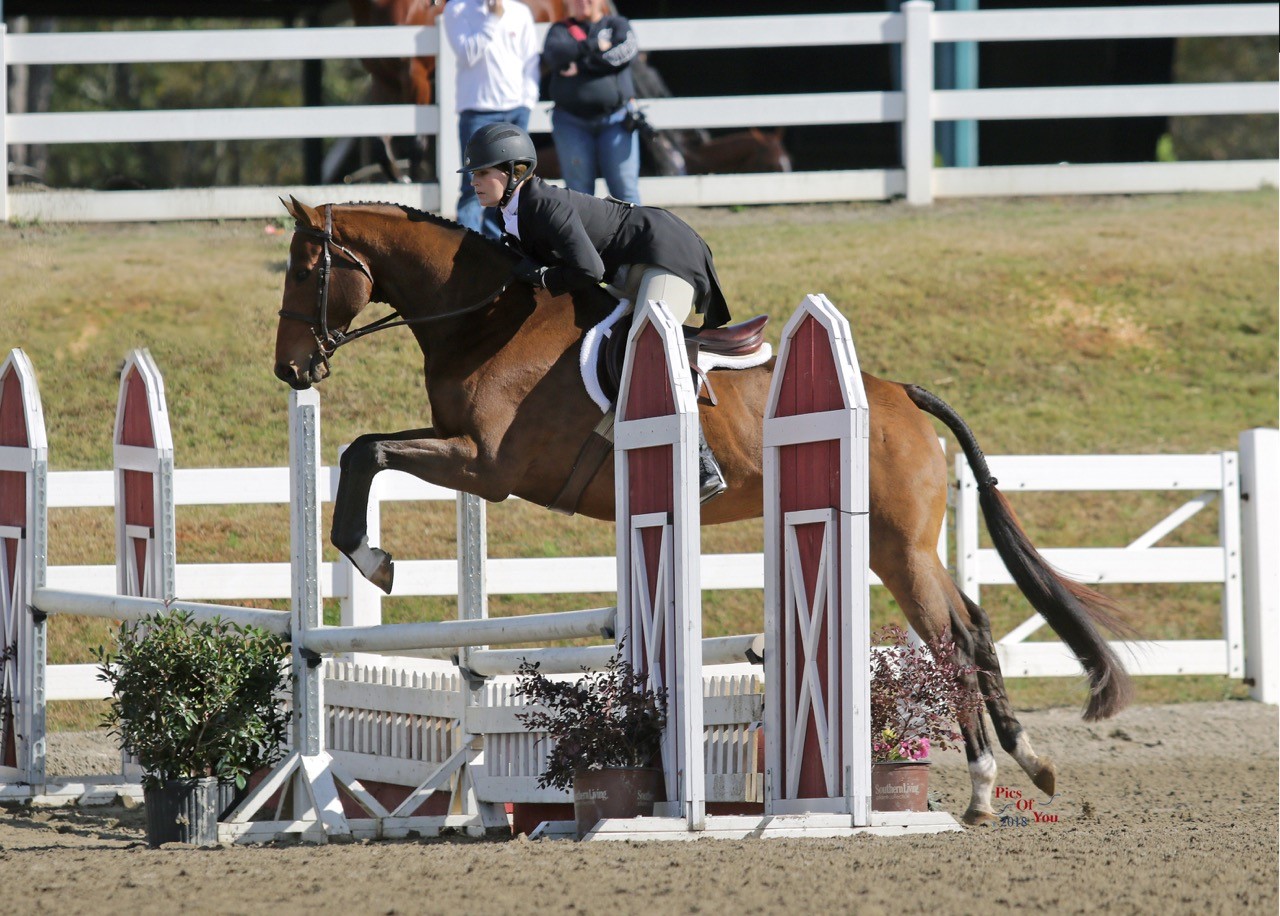
Morgan Osbaldeston competing 16 year old gelding Always
the Optimist, a Canter PA alum who raced as Simply Stylin.
Photo credit PicsofYou.com
Getting involved with CANTER PA went hand in hand with her career as a rider and trainer. “Growing up, Thoroughbreds were the breed of choice for sport. Most were purchased directly off the track, although it wasn’t uncommon for riders to attend local auctions in search of prospects. While following online forums in the early 2000s, I was surprised to see how many ex-racehorses were in desperate need of rehoming. To me, that was a solvable issue. While they had gone out of fashion for some, they always seemed to be in demand for local riders competing on a budget. It’s a win-win.
“The race industry needs to find a safe outlet for horses who are young, athletic and perfect for so many second careers; at the same time, sport riders are perpetually struggling to ride and compete with limited funds,” Sue continued. “What better match can be made? OTTBs are ideal prospects in that they are purposefully bred, registered, professionally started, maintained in regular training and well-suited to nearly all equestrian disciplines, all for a fraction of what you could find in similar prospects with different breeding. When I learned about CANTER’s trainer listing services, I wanted to do my part.”
CANTER PA’s primary location has always been Penn National Racecourse in Grantville, Pennsylvania, which runs races year-round. CANTER PA conducts weekly visits to help take photos and gather information for their online trainer listing service, which places around 250 horses per year. “I have to confess, when I began volunteering, I didn’t have any interest in horse racing and I had an antiquated view of the track,” Sue said. “All biases immediately dissolved once I met people on the backside and saw how well cared for most horses were. The methods and materials were different from what I was used to seeing in the sport horse world, but the love of horses is at the center of both worlds.”
Since its founding, CANTER PA has also expanded to assist horses at Presque Isle Downs in Erie, Pennsylvania, which offers seasonal racing. Many trainers relocate to other racetracks in the off-season, but CANTER PA stepped in to create an end-of-meet event showcasing the 40–50 horses each year who need immediate placement. Interested buyers get a behind-the-scenes view of a barn at the racetrack and to see the horses presented, with an on-site veterinarian to do immediate pre-purchase exams. There are always many quality prospects and all horses are priced at $3,500 or less.
In addition to the listing services and showcase, CANTER PA offers a Gelding Incentive Fund and educational scholarships. The Gelding Incentive Fund was created to assist in the costs of gelding retiring colts, which both reduces low-end breeding and makes the colts more suitable for average riders. Educational scholarships are offered annually in memory of Becky Julian, a longtime supporter. The scholarships are awarded to Thoroughbred owners in the Mid-Atlantic area for lessons and training to support transitioning an OTTB.
Growing Success
Fostering the development of riders and trainers who can safely transition a horse off the track is a vital mission of CANTER PA, unlike other aftercare non-profits that physically take in, rehabilitate and begin retraining OTTBs. “We really applaud those efforts and network regularly with those organizations, yet there is still a much larger number of horses retiring than can be placed through accredited non-profits,” Sue explained.
“In that way, I feel our trainer listing service provides a vital role in filtering the bulk of those horses directly into private homes and alleviating the financial burden on intake programs. Our listing service incentivizes trainers to retire their horses sound, often rewarding them with a few thousand dollars for a horse that may no longer be competitive on the track. That money can then be directed to the purchase of their next racehorse and the horse has a great chance for a successful second career.”
That success might look different for each horse. “I consider any horse in a home where he’s appreciated and well cared for a success,” Sue said. “It’s great to see CANTER alums excelling at the upper levels of any sport, breaking negative stereotypes about Thoroughbreds. At the same time, it’s equally exciting to see alums excelling as trail horses or family horses, as they’re breaking a different, but often equally negative, stereotype.”

And sometimes Sue sees success not just in the horses placed, but in the people who use their services as well. “I meet a lot of owners and trainers on the backside, and while most are very supportive of aftercare, there were a few in my early days with CANTER PA who were slow to understand its importance. One day, by chance, I ran into a particular trainer who had previously expressed his disinterest in our program, but that day he told me he had a horse in need of a home.
“Amazed that the trainer was finally willing to work with me, all I could think while driving to his farm was, Please let this horse be good-looking! I wanted nothing more than to show that our program worked,” Sue recalled. When she got there, the trainer brought out an older, completely plain bay gelding that was covered in mud — and blind in one eye.
“The trainer went on to tell the story of this horse, previously owned by a good friend. This loyal fellow would dutifully guide his owner home on his back after evenings of ‘over indulgence,’ modestly contained in the man’s yard with only a strand of caution tape stretched from tree to tree. It was nice to see that this horse was so valued by the trainer and I did my best to market the horse, fearing no one would give him a chance. Much to my surprise, he was placed quickly.”
The very first person who came to see the horse was so overwhelmed by his kindness that she brought him home for her father. Not only did he prove the perfect trail horse for her dad, she competed him in eventing herself and stayed in touch for many years.
“It was the perfect fit and he was loved just as much in his new home as he had been in his last,” Sue said. “While his placement was reward enough, a week after the horse sold, the trainer stopped me again. He had more horses for me to list and became a regular user of our program. Not only could he make more money selling to the sport world, he was pleased to see people enjoy these horses after their race careers were over.”
But for Sue, it really comes down to one thing. “Personally, I do it for the horses,” she said. “When I walk the backside of the racetrack, I see so many deserving horses with bright futures. They just need an opportunity to shine, and if donating an hour or two of my time can give them a chance at a quality life after racing, I’m happy to do so.”
For more information, visit canterusa.org/Pennsylvania

Sign up for our mailing list to stay up to date with all things Sidelines!