By Doris Degner-Foster
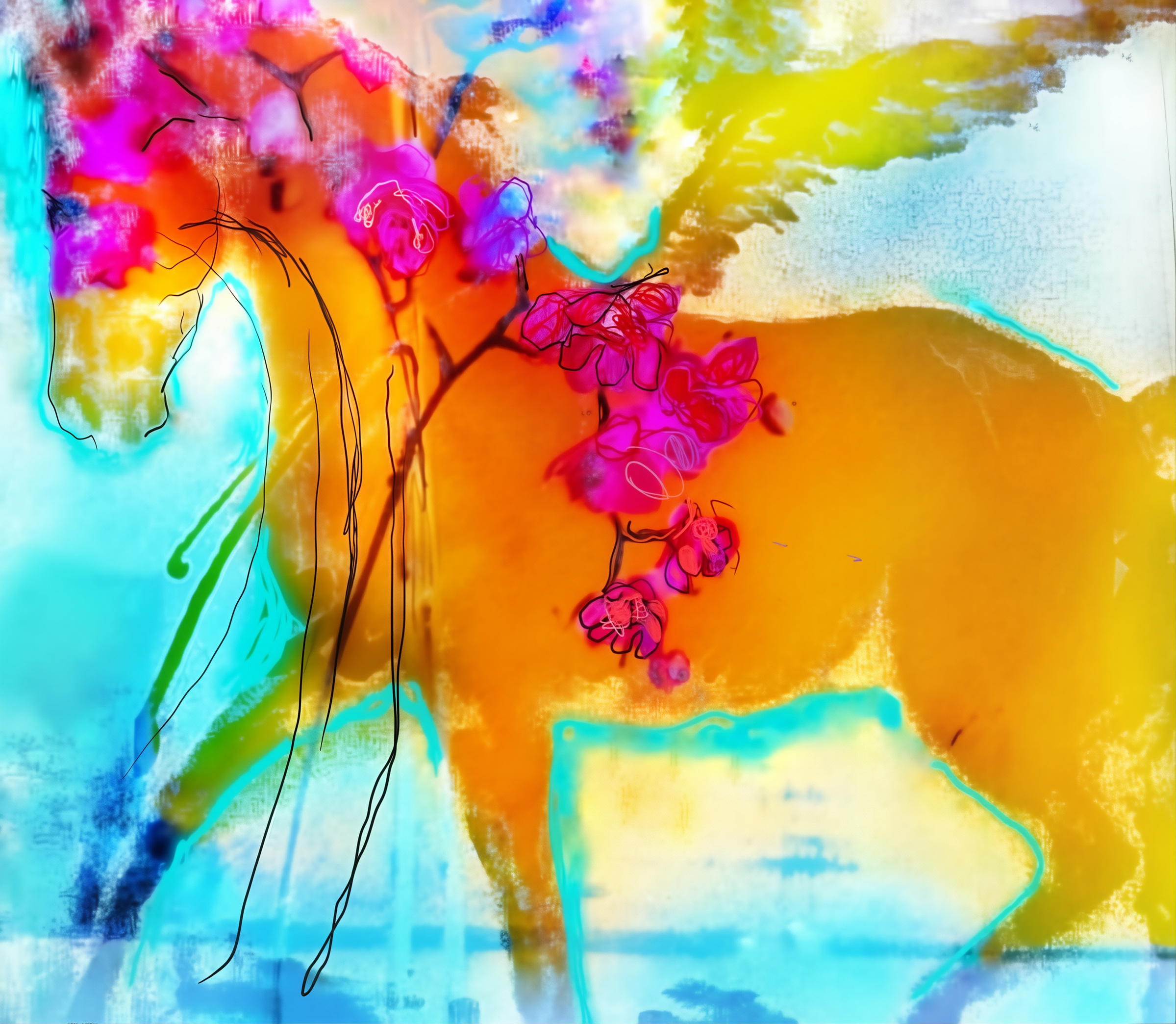
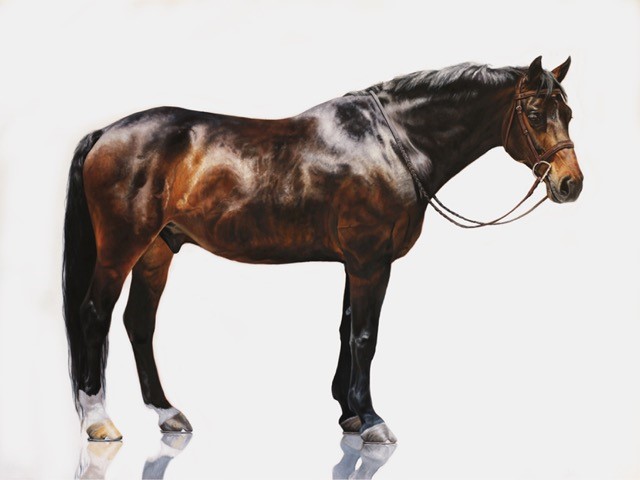
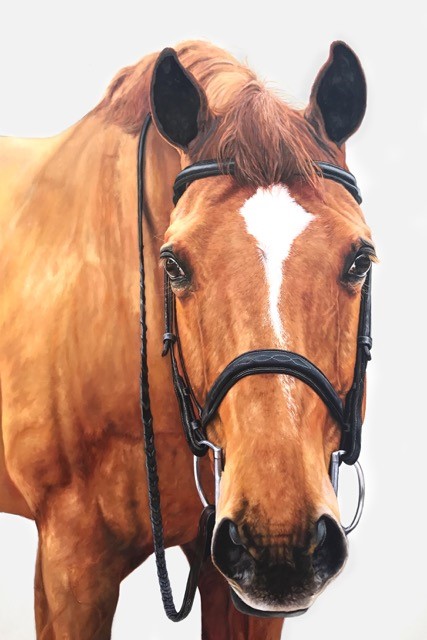
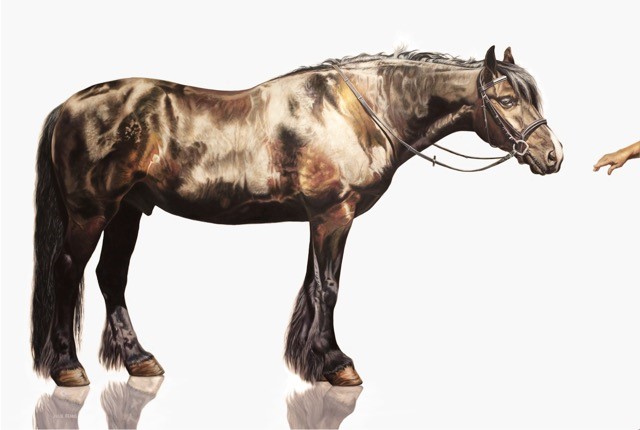
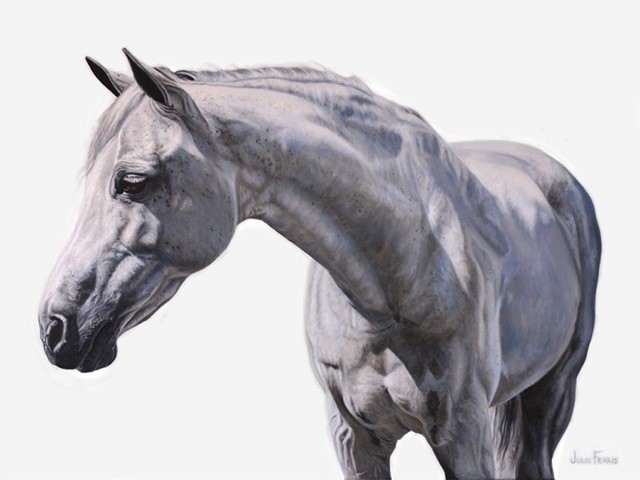
The horses in Julie Ferris’ work look as though they could step off the canvas, especially in her life-sized paintings. Her trademark style of using a white painted background highlights her subject, showing the character of each individual horse through their facial expression and unique physical components.
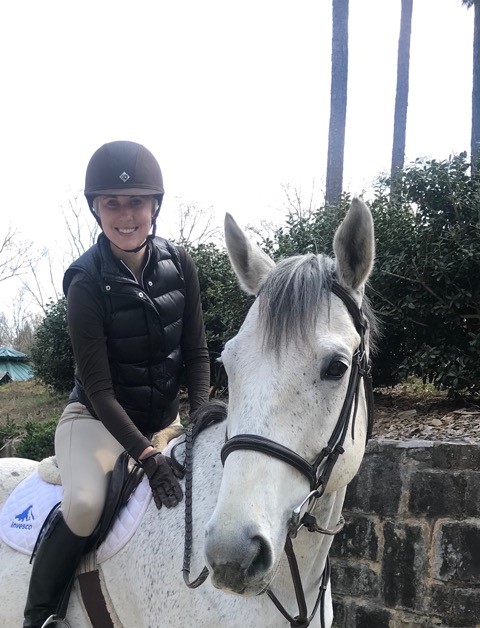
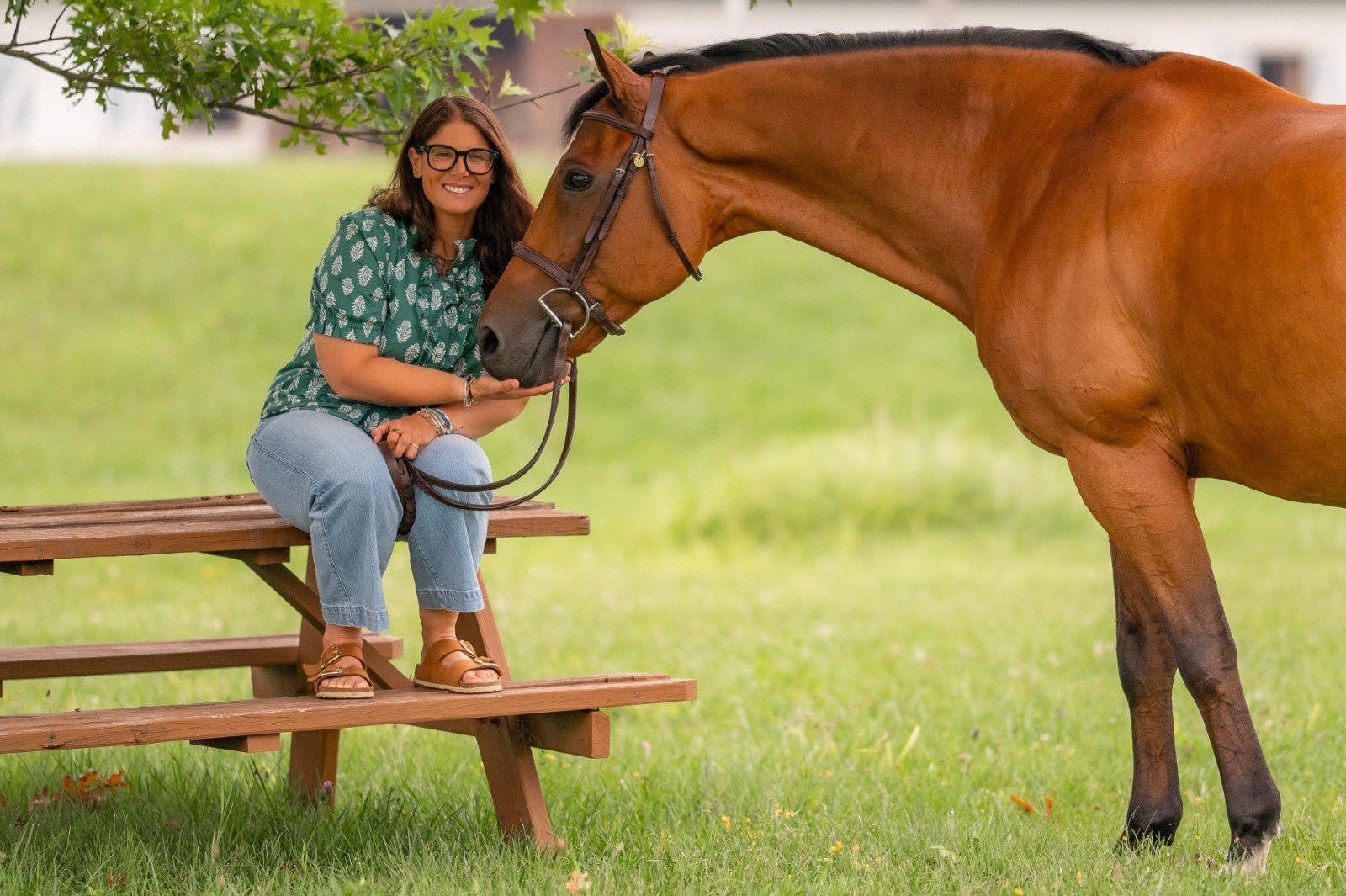
As much as Julie enjoys painting, she admits that she almost always prefers to be in the saddle: That connection is what keeps her art fresh, and because horses have done so much for people, depicting them in her work is a way of giving tribute to them.
“My love for horses through riding is really the thing that has fueled my passion for being an equestrian artist,” Julie said. “I think that if I didn’t ride and have that connection and that experience in my background, the passion would be missing in my work, so it’s a very integral part of my journey and development as an equestrian artist.”
Her work is influenced by her desire to treat the horse with justice and respect, with the goal of developing a good relationship during riding and training. “When you’re riding, it’s a question of whether your horse is just tolerating you or are you creating the sort of relationship where the horse is wanting to do the work and is happy and comfortable,” Julie said. “Since we as humans are always the first initiators — the horse doesn’t choose us, we choose them — it’s our job to make sure we’re doing our best and educating ourselves when it comes to riding and caring for horses.”
 A Family Tradition
Horses were a family tradition for Julie. Her grandmother rode Tennessee Walking Horses and her mom grew up in Atlanta, Georgia, with the advantage of having horses available to her, and in turn, so did Julie. She rode purely for fun as a child without the pressures of showing.
“Starting out, I took a lesson a week and although showing was not something that I was able to participate in, I was riding whenever I had the opportunity and I just loved it so much that I was okay with that,” Julie said. “I remember leasing a horse for a little while named Scat Man, which was fun, but I ended up stopping after a few months because he had a bit of an attitude problem.”
Julie enjoyed her regular lessons on school horses with now retired trainer Vicky Hays, whose daughters are trainers and riders Holly Orlando and Heather Hays. Julie remains good friends with Vicky, who was her first exposure to riding lessons, and although she did other sports in high school, Julie returned to Vicky to help her prepare before trying out for the riding team at Savanah College of Art and Design.
“I didn’t actually start competing until I went to SCAD where I rode with the Intercollegiate Horse Show Association and showed in hunt seat equitation,” Julie remembered. “It was another aspect of riding that I really enjoyed. I’m a rather competitive person and wanted to win, but I also just wanted to ride well and do my best.”
Developing Her Talents
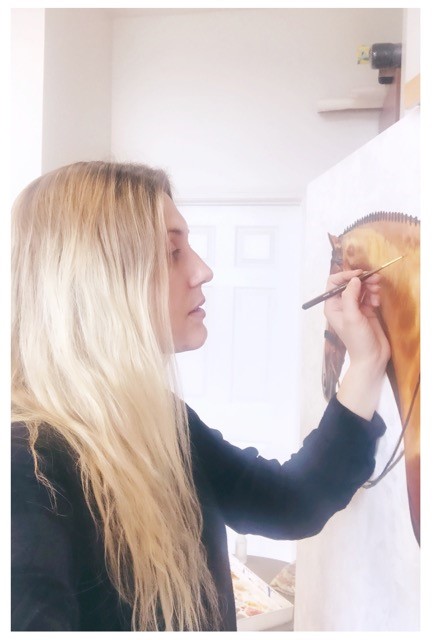
Julie remembers as a child drawing horses using the supplies at hand, mostly pencils and crayons, and feels that it was her way of communicating using her art at an early age. Her artistic talents were encouraged in school but she became more serious about art as a career when she was in high school, taking any and every advanced art course she could. She would spend many days in the art room during lunch break to continue working on her projects.
Julie made it her personal mission to be an equestrian artist who brought respect and legitimacy to the art form. “Horses are amazing animals and they are meant to be respected, both when you are with them and in art form,” she said.
“I decided I was going to Savanah College of Art and Design because of their elite art programs and renowned equestrian team,” Julie said. “I liked the fact that I could ride there, major in painting and minor in equine studies. It was the perfect combination of all the things I wanted to do.”
In her classes at SCAD, Julie learned how to utilize different oil techniques as she sought a distinctive signature style for her work.
Emerging Style
After graduating from SCAD in 2012, Julie was excited to get started in her career as an equine artist, but as she analyzed the work that she had done for her classes, she realized that there was no visual consistency other than that they were all somehow “horse related.” Julie wanted to develop a signature look and style while adding emphasis to the horse so that her work would become recognizable.
“I studied other artists’ work trying to discover a way I could do something different, new, fresh and contemporary with a nod to classical design,” Julie said. “I was brainstorming, trying to figure out what I wanted my visual thumbprint to look like as an artist; how do I want people to know my work? How do I want people to feel when they see my work? I wanted my work to be recognizable so that people would be able to know it was mine even without seeing the signature.”
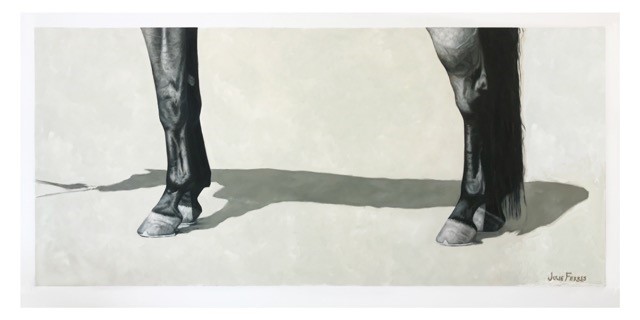
It was as Julie decided to simplify her life and thoughts that she gravitated toward the use of a background that allowed the horse to be seen without competing with anything else on the canvas. The horse in the work is grounded, not by a typical grass footing or arena, but by a reflection making it appear as if the horse were standing on glass or ice. Julie’s inspiration for this visual element came from an interesting experience.
“The idea for incorporating the reflection came from one of my projects at SCAD, and the fact that I’ve always been very drawn to reflections in actuality and in thought,” Julie said. “The assignment was to create a project based on technology, so I made a 3-D sculpture of a white horse out of clay standing on top of an iPhone, and I put a reflective surface where the screen would be so it really felt like a phone. The message was that before we had technology, horses were our technology: We used them for everything and now we use our phone for everything. When I took photos of this project there was a reflection of the horse sculpture on the ‘phone screen’ and I liked how it looked so I took the reflective idea from that project.”
Thriving Business
Julie is based out of her studio in Atlanta and her work encompasses commissioned work as well as creative projects, some of which are available through Spalding Nix Fine Art. For commissioned projects, Julie is very thorough in her preparation before she begins painting. She begins by spending time talking to the client about their horse, learning the background about their relationship before traveling to meet the horse and do the pre-painting photoshoot.
“I like to meet the client and horse in person because it’s personal to me and that’s an important part of the process that automatically creates a higher level of engagement in my work. I really feel strongly that I capture the best images myself for my work, which is why I typically require a pre-painting photoshoot. Since art is a personal expression, meeting the horse and client is a part of the personal aspect of that.”
Julie works on commissions locally in Atlanta and also travels to meet clients and their horses. The trips are beneficial as well since Julie finds that travel is a great way to gain new perspectives and inspiration.
“I did a photo shoot in Seattle where a client had three horses but it was her ‘heart horse’ that was the intended portrait subject. I ended up taking photos of all three horses though I did just the one commission she had planned on,” Julie said. “I keep a file and as long as the owners don’t have any issues with it, I consider the unused photos for future work. It turned out that one of the other two horses I just loved ended up tragically passing away before his time about a year after the photoshoot. I decided I wanted my first life-size piece to be of him as a memorial of sorts.
“Although he was a wonderful, sweet horse with an amazing character, he was not the typical horse for a commissioned work. He was not a highly accomplished show horse, but more of a kind and gentle, everyday horse that many people could identify with; a horse that was both ordinary and extraordinary,” Julie said, “He was just a pasturemate and general riding horse, but he was dearly loved. I was really drawn to that kind of humble story and felt it needed to be shared.”
As in many of Julie’s paintings, this life-sized work includes a hand gently stretched out to the horse in a nod to Michelangelo’s “The Creation of Adam.” “My goal was to illustrate the creation of the relationship we humans initiate, good or bad, with our horses and even each other. I want my work to make people think more about these relationships — and what they’re doing, or not doing, to make them better.”
For more information, visit www.julieferrisart.com
Photos courtesy of Julie Ferris
Sign up for our mailing list to stay up to date with all things Sidelines!